Zero-shot style transfer and content/style probing
Independent content and style labels from Things objects × ArtBench styles. Linear probes on frozen ViT CLS tokens improve style retrieval relative to raw cosine kNN on late CLS.
Overview
We ask whether a linear map on frozen ViT CLS can improve artistic-style retrieval when raw cosine kNN on the same token does not.
Data: Things100 × ArtBench
We build a UCAST-style grid: object concepts from THINGS stylized into ArtBench artistic domains. Content and style labels are independent, so the same image can be queried for content retrieval or style retrieval.
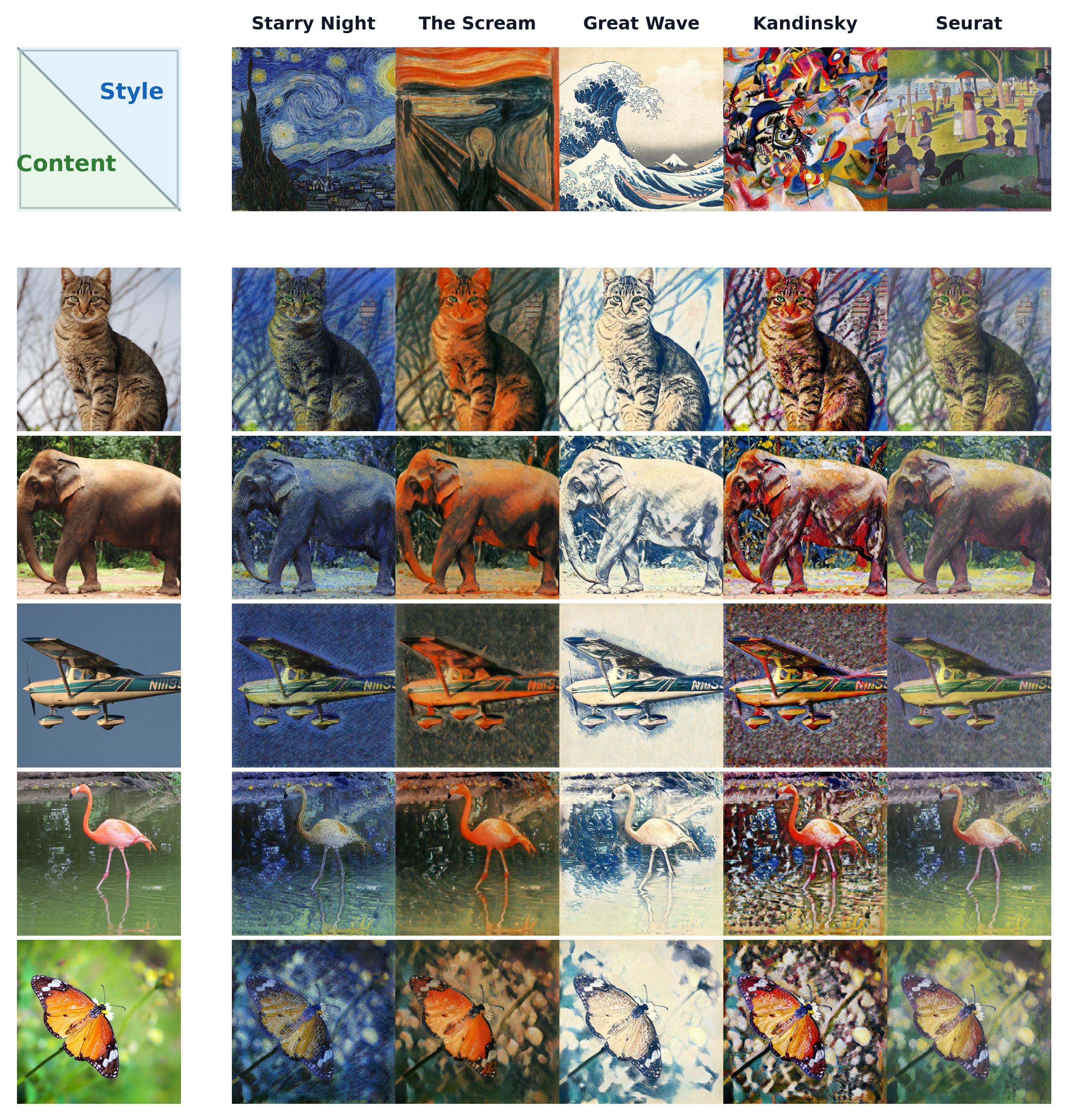
UCAST pipeline
The benchmark is a Cartesian product: 1,000 content photographs × 1,000 style
paintings, stylized one pair at a time by style_transfer.py into
ucast_things100_artbench1000/. That is 1,000,000 JPEGs.
Content and style pools
-
Content: THINGS, 100 categories × 10 images = 1,000.
setup_things_content.pytakes the first 10 files per category in sorted zip order and writes{category}_{1..10}.jpeg. The category list is frozen inmanifests/content_categories.txt. -
Style: ArtBench-10 train parquet, 10 classes × 100 images = 1,000, pulled by
download_artbench_1000.pyand numbered 1 to 1000. Per-image provenance is inmanifests/artbench_1000_sources.csv.
The 5×5 grid above is a display subset built from canonical paintings (Starry Night, The Scream, and so on) so the figure is readable. The probes never see it. Training and evaluation use the 1,000 ArtBench styles.
Inference
Framework is UCAST[1], but the forward pass is written out
inside style_transfer.py rather than called through
CAST_pytorch/test.py, since a million pairs makes per-image process
launch the dominant cost. VGG-19 truncated to the first 31 layers (through relu4-1)
encodes content and style. AdaIN then matches the content feature channel mean and
standard deviation to the style feature mean and standard deviation at that layer,
and the decoder (latest_net_Dec_B.pth) upsamples back to RGB. Weights
are models/vgg_normalised.pth,
checkpoints/UCAST_model/latest_net_AE.pth, and
latest_net_Dec_B.pth.
- Both inputs at
224×224, normalizationrange_5(mean 0.5, std 0.5, so tensors in [-1, 1]), float16. - Written as JPEG quality 90, named
{contentRel}_stylized_by_{styleRel}.jpegwith nested folder separators flattened to_. - Existing outputs are skipped, so a run is resumable after a preemption. Each file is written to
.tmpand thenos.replaced, so a killed job never leaves a half-written JPEG that the skip logic would later accept.
Splits
dataset.py, seed 42. The instance split holds out 20% of the content
image names per category, 2 of the 10. The style split holds out 20% of the style
categories. This is what turns a million stylizations into a retrieval set: queries
and gallery come from held-out content names or held-out styles, not from pairs the
probe was fit on.
Method: dual CLS probes
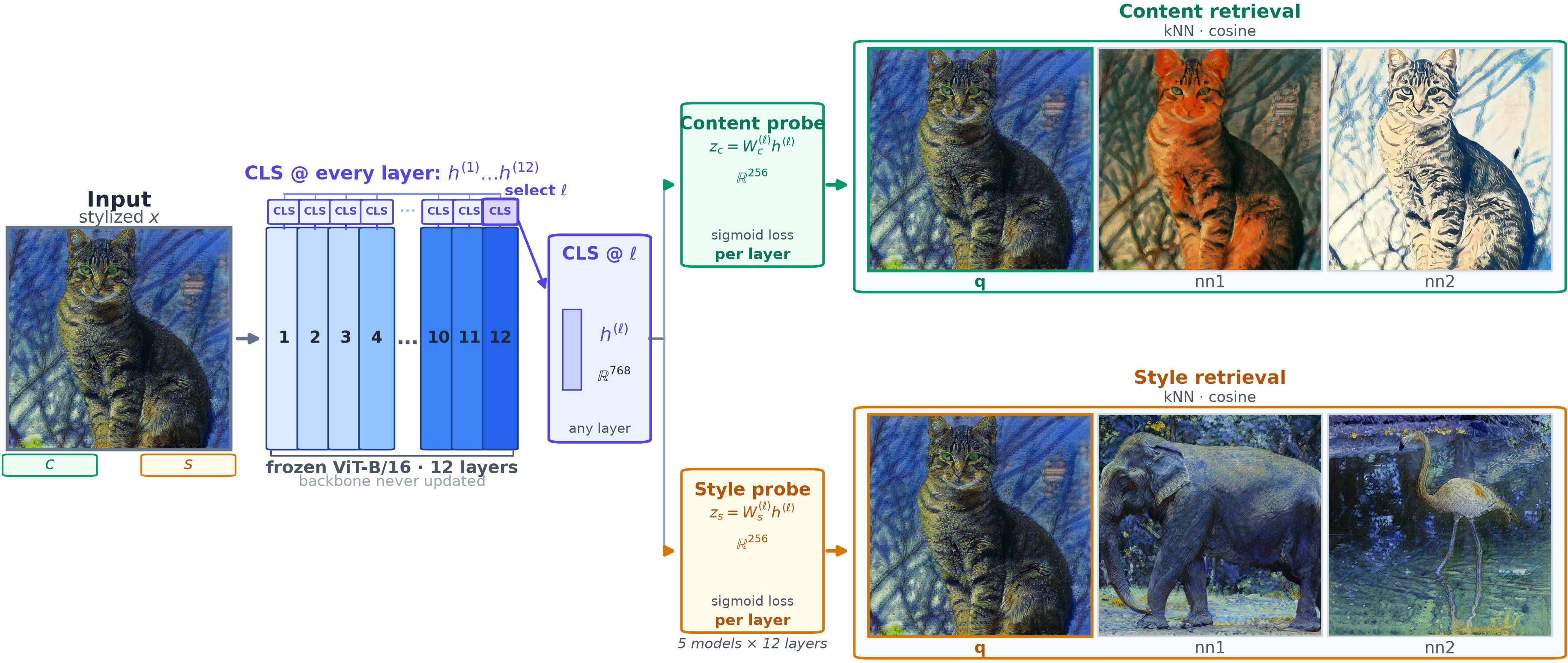
Freeze a ViT-B/16. At each layer, map CLS h^(ℓ) ∈ ℝ^768 with two
independent linear heads to L2-normalized 256-D content and style embeddings.
Both heads train under a pairwise sigmoid focal loss: build the
512 × 512 cosine matrix for a batch, treat each off-diagonal entry
as an independent same-class/different-class decision, and discount the pairs
the probe already scores correctly.
Batches are square by construction, C = 32 classes ×
M = 16 images, so the positive count per batch is fixed rather
than left to chance. Focal γ = 1.0 with α = 0.75 on
the positive class, which is the minority here at roughly 33:1. Temperature and
logit bias are learnable and used only during training; evaluation is zero-shot
cosine kNN (Recall@1 / mAP). The α choice, the per-group count normalization,
and why not InfoNCE are written up on the poster page:
pairwise sigmoid focal loss.
Results
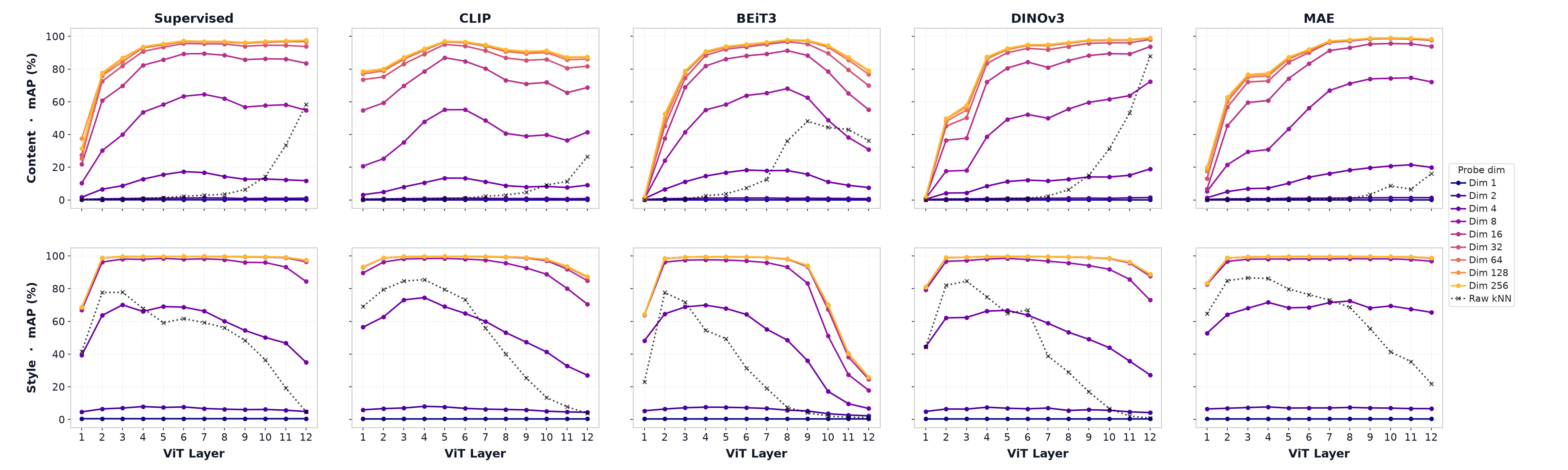
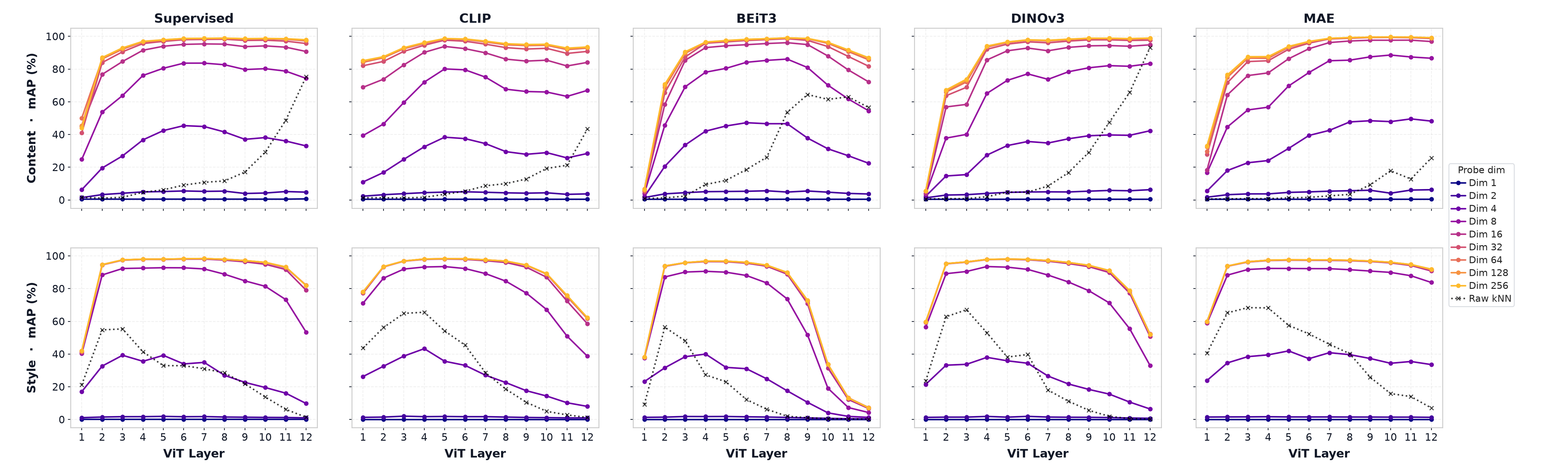
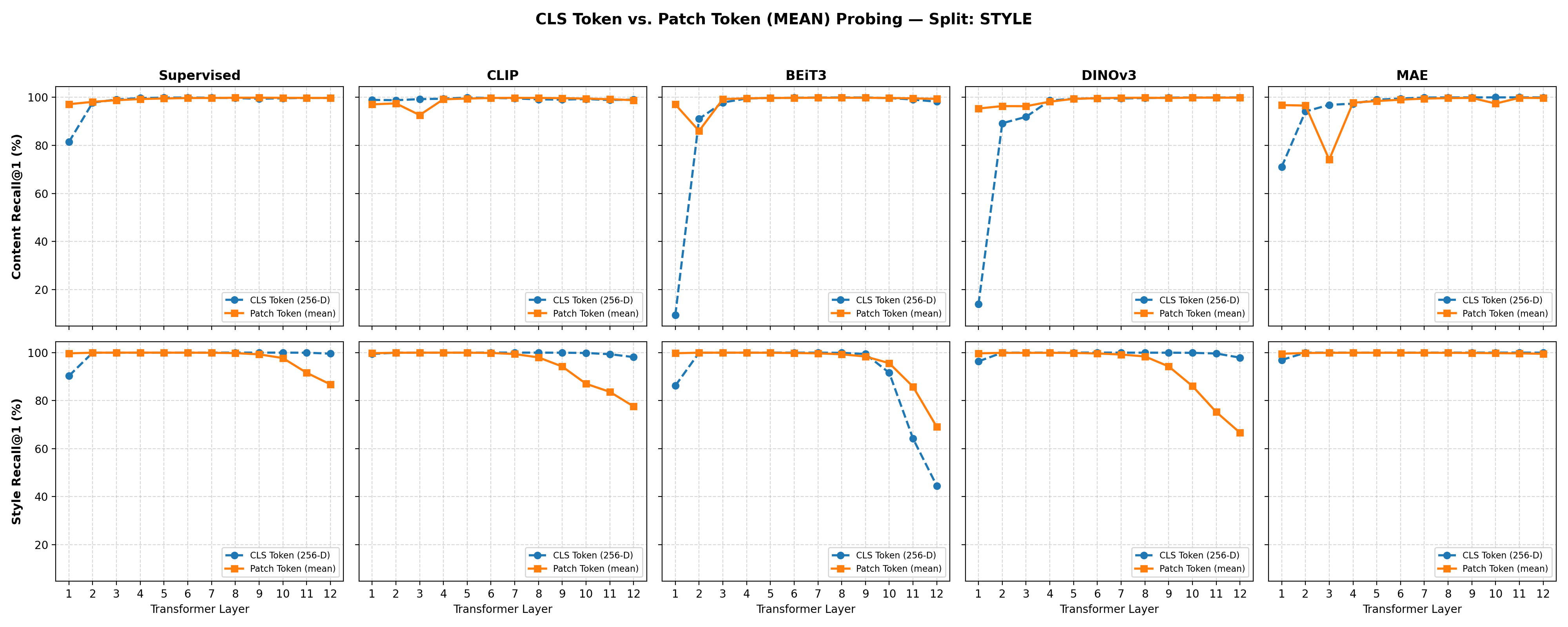
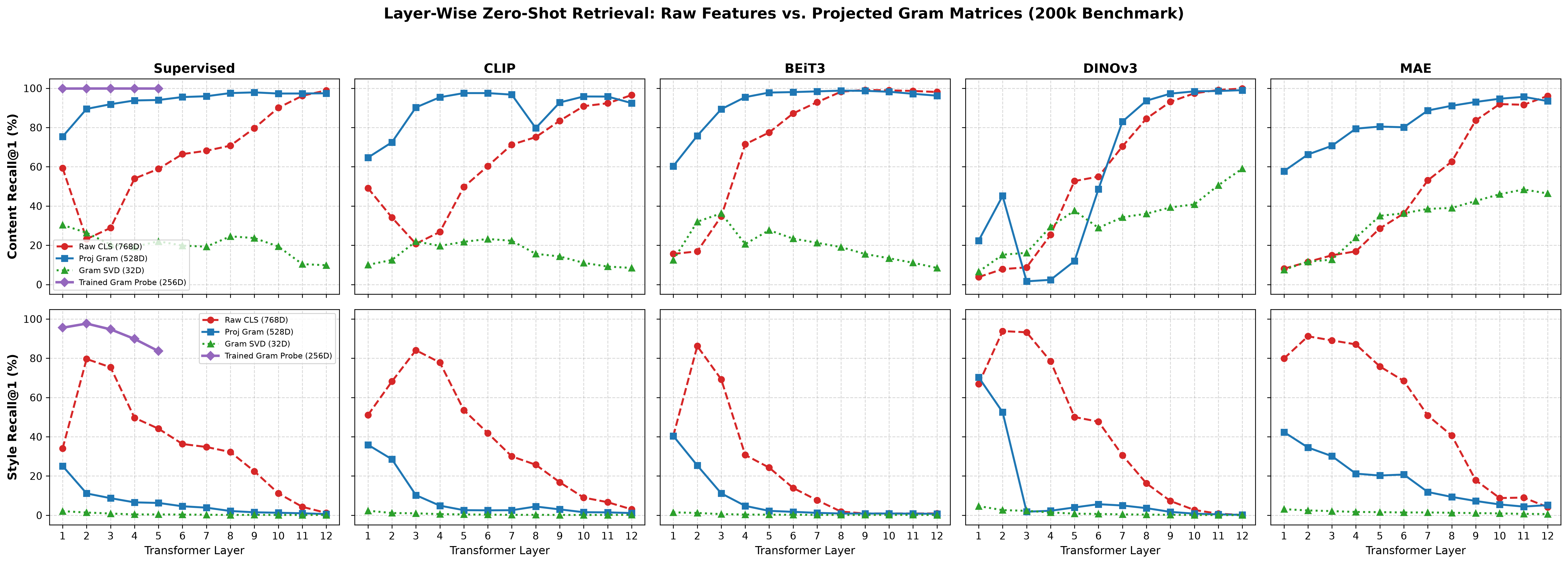
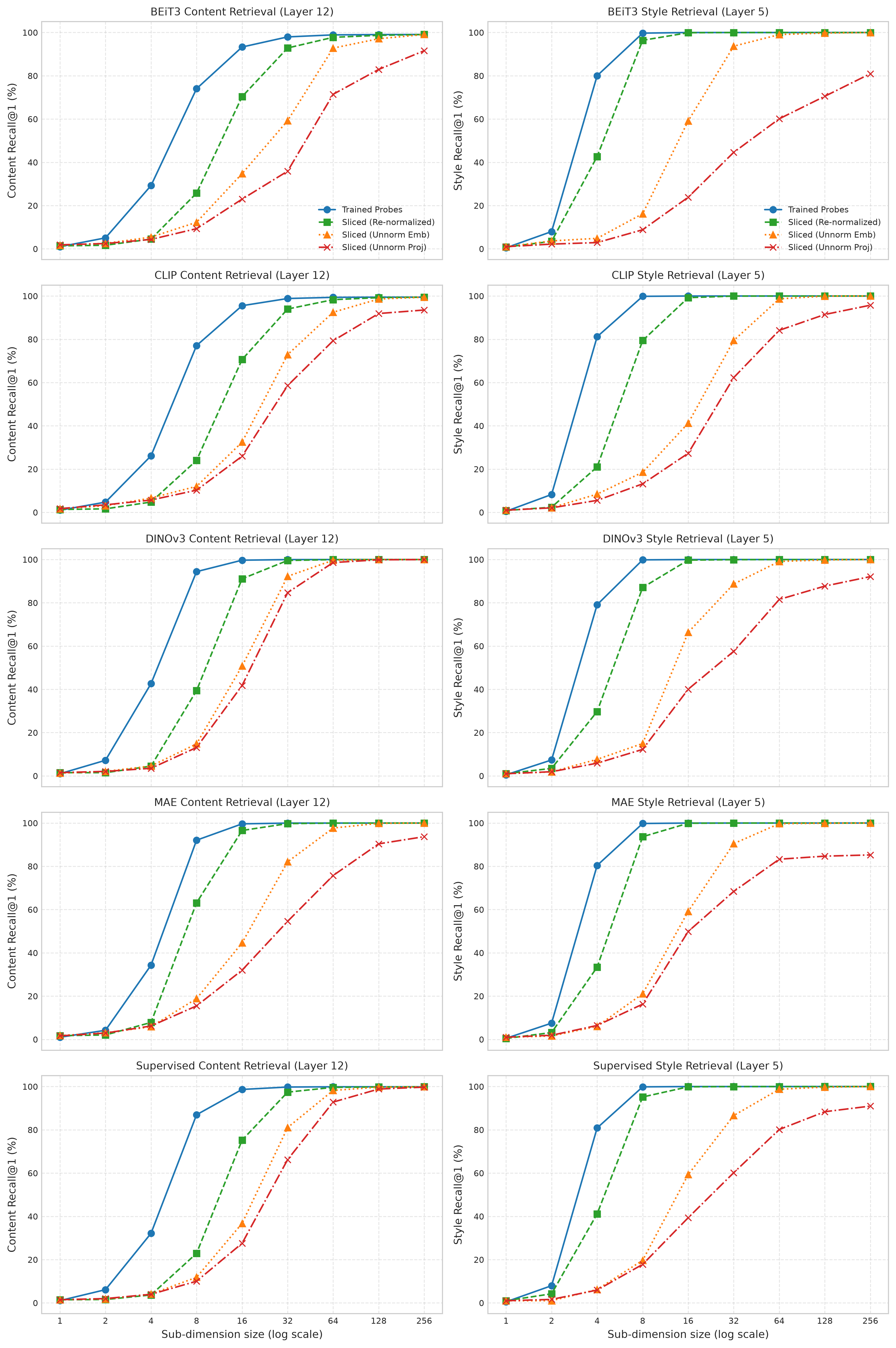
Probes raise style Recall@1 / mAP relative to raw CLS. Higher probe dimensions help. Content retrieval is generally easier than style on this set.
CLS vs patch / Gram
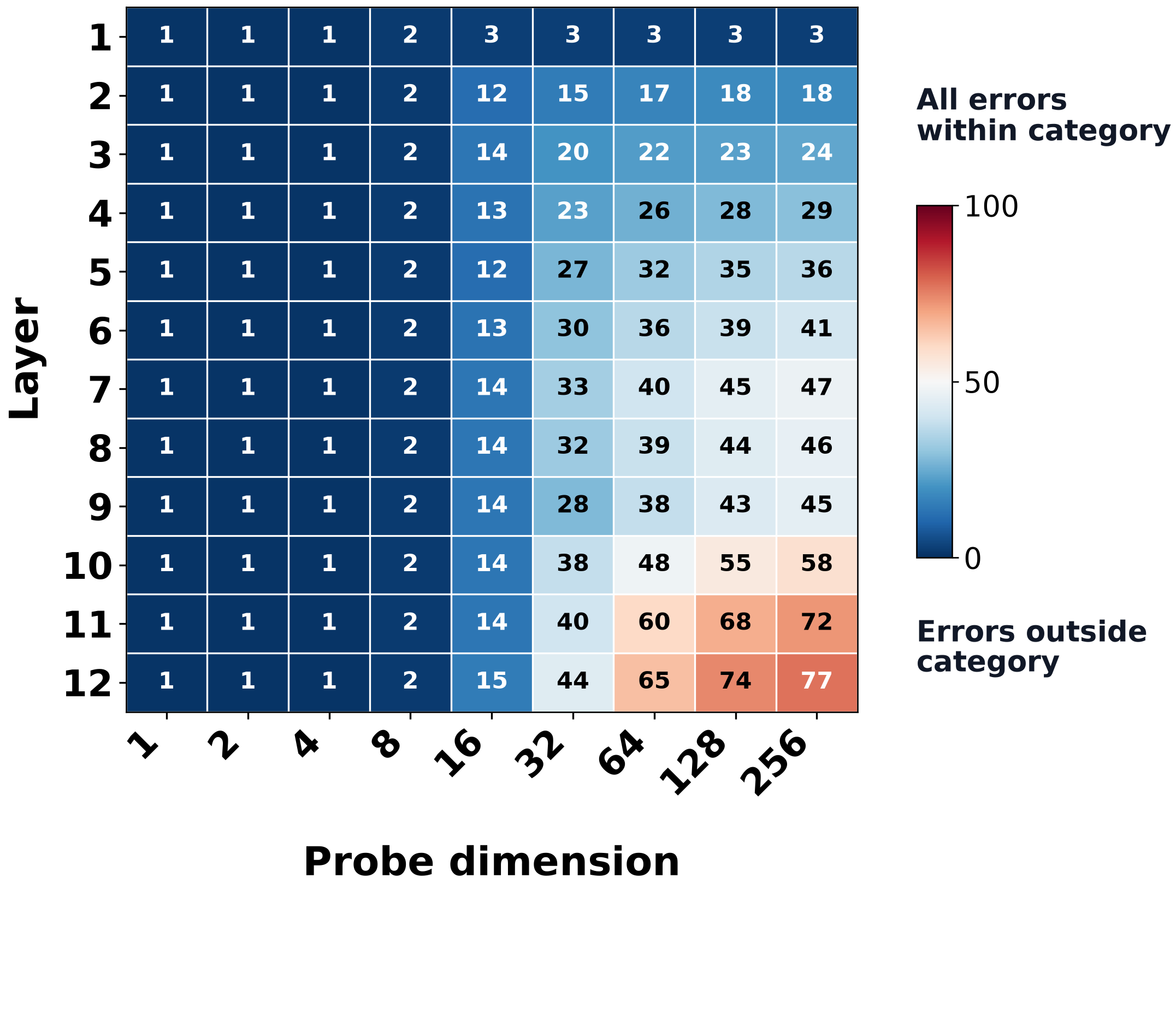
Error structure
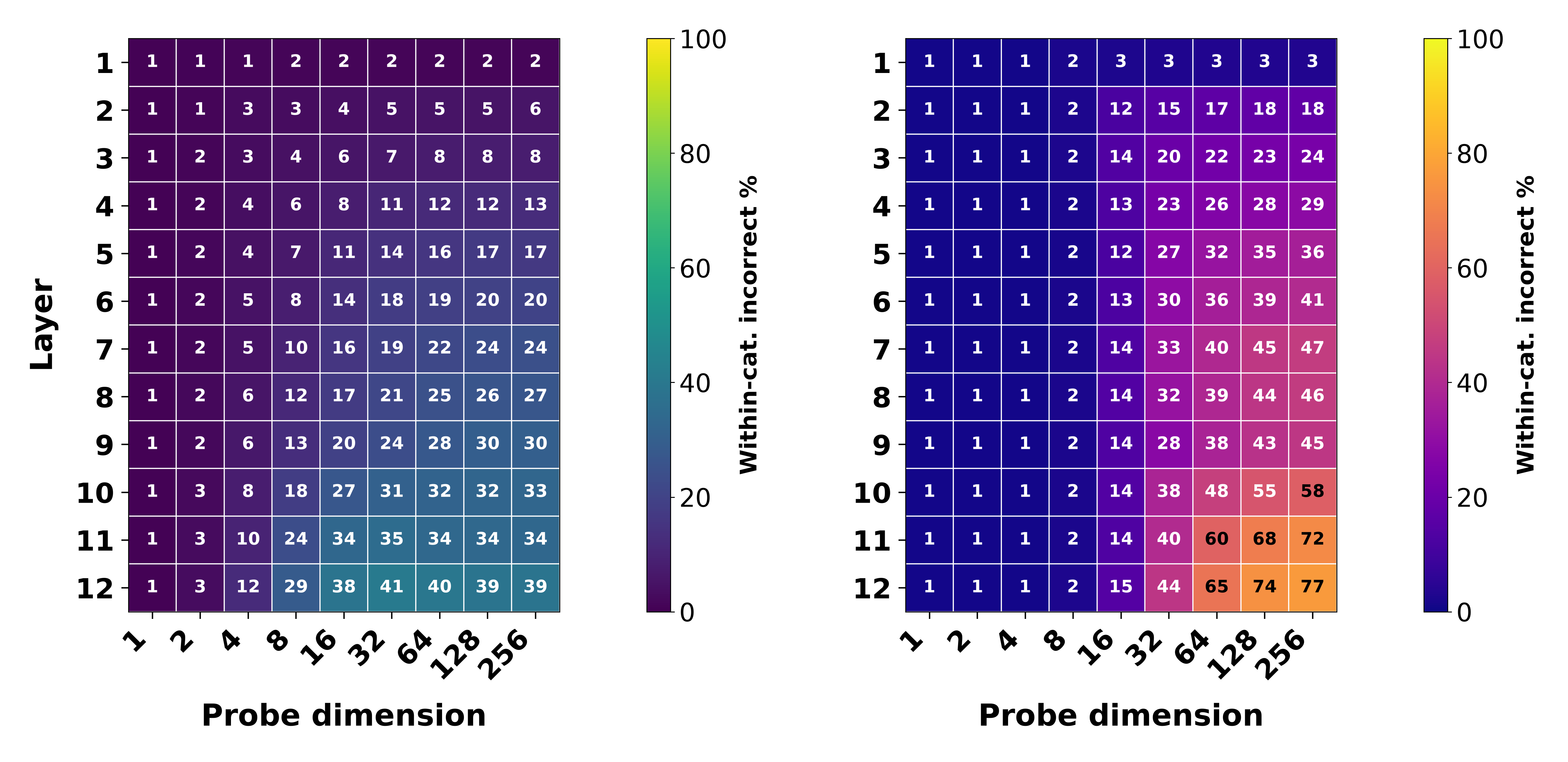
For incorrect style-probe neighbors, the fraction that stay in the query’s object category increases with probe dimension and depth.
References
- Zhang et al., A Unified Arbitrary Style Transfer Framework via Adaptive Contrastive Learning, arXiv 2023.
- Hebart et al., THINGS: A database of 1,854 object concepts and more than 26,000 naturalistic object images, PLOS ONE 2019.
- Liao et al., The ArtBench Dataset: Benchmarking Generative Models with Artworks, arXiv 2022.